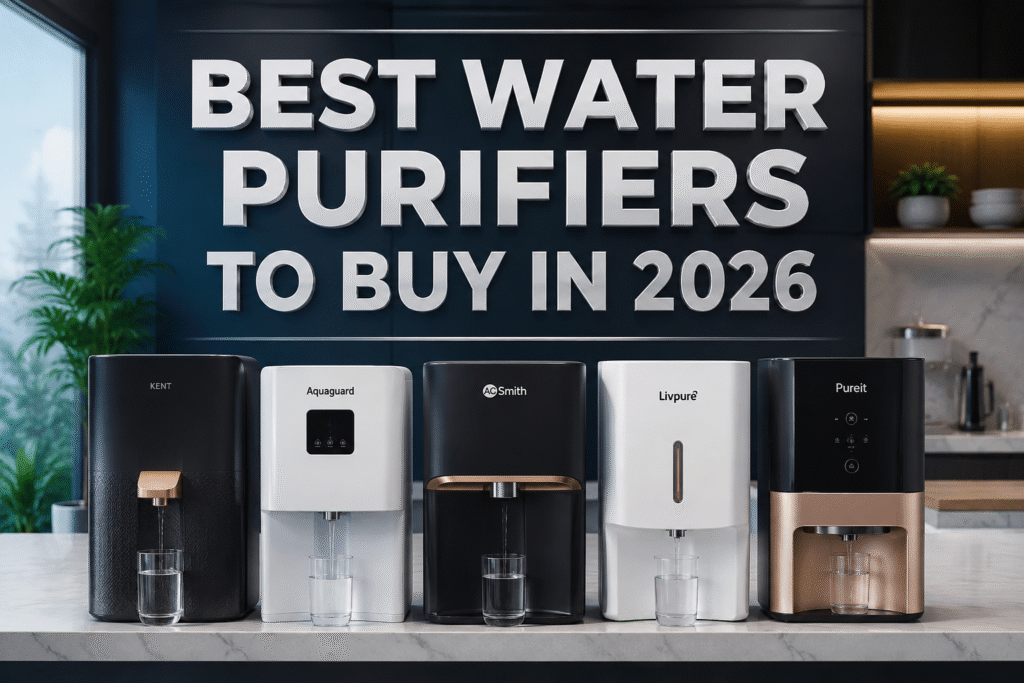

A good water purifier should match your water quality, not just your budget. Here’s a practical buying guide for 2026.
1. Test your water first (most important)
Spend ₹200–₹300 on a TDS meter before buying. Your TDS determines the right purification technology.
| Water condition | Recommended purifier |
|---|---|
| Municipal water, TDS below 200 ppm | UV or UV+UF |
| 200–300 ppm | UV+UF or RO (depending on contaminants) |
| Above 300 ppm (borewell/tanker common) | RO + UV + UF with TDS controller |
Don’t buy an RO purifier just because it’s popular. If your water already has low TDS, RO may remove more minerals than necessary.
2. Choose the right technology
- RO (Reverse Osmosis): Removes dissolved salts, heavy metals, and high TDS. Best for hard water.
- UV: Kills bacteria and viruses. Best for municipal water with low TDS.
- UF: Removes suspended particles and some microbes without electricity.
- Sediment + Carbon filters: Improve taste, remove dirt, chlorine, and odors.
For most Indian homes using borewell or tanker water, an RO + UV + UF combination is a safe choice.
3. Ignore marketing gimmicks
These features usually don’t justify paying extra:
- Copper infusion
- Alkaline water
- Hydrogen water
- “12-stage” or “15-stage” purification
The filtration quality, service network, and maintenance costs matter much more.
4. Check water recovery
Modern RO purifiers should recover more water than older models.
Look for:
- 40% or higher water recovery
- Auto-flush feature
- Reuse reject water for cleaning or gardening if possible.
5. Calculate the 5-year ownership cost
Many buyers focus only on the purchase price.
Also check:
- Annual filter replacement cost
- AMC (Annual Maintenance Contract)
- Availability of spare filters
- Service charges
A purifier costing ₹15,000 with ₹2,500 yearly maintenance can be cheaper over five years than one costing ₹10,000 with ₹5,000 yearly maintenance.
6. Verify after-sales service
Before buying, confirm:
- Service center availability in your city
- Warranty on filters and electrical parts
- Installation charges
- Availability of genuine replacement filters
Good service is often more valuable than an extra feature.
7. Pick the right tank size
- 1–2 people: 5–6 L
- 3–5 people: 7–8 L
- 6+ people: 9–10 L
8. Quick buying checklist
- ✅ Measure your water TDS.
- ✅ Choose RO only if your water needs it.
- ✅ Compare annual maintenance costs.
- ✅ Check water recovery efficiency.
- ✅ Ensure a good local service network.
- ✅ Prefer brands that use standard replacement filters.
- ✅ Compare the 5-year cost, not just the purchase price.
Best Water purifiers to buy in 2026:
V-Guard Zenora RO Water Purifier for Home
Native M2 Pro Water Purifier by Urban Company
Native M0 Water Purifier by Urban Company
Livpure Glo Star Copper Water Purifier
Atomberg Intellon – India’s 1st Adaptive Water Purifier
Aquaguard Designo NXT 9-Stage Under The Counter Water Purifier
Pureit Eco Water Saver RO Purifier
KENT Supreme Plus Alkaline+Copper RO Water Purifier
Aquaguard SURE Delight Aquasaver RO+UV+UF+MC Water Purifier
AO Smith Z9 Pro Instant Hot and Ambient Purifier
Aquaguard Blaze Insta Hot & Ambient RO Water Purifier
AO Smith Z2+ Luxe RO Under sink Water Purifier
Livpure Allura Premia Water Purifier
KENT Max UV Water Purifier
Aquaguard Ritz Pro RO+UV+Copper Water Purifier
Aquaguard Marvel NXT Active Copper RO+UV+UF + 1 Free Alkaline Bottle
For all kinds of Daily Deals, Join our Telegram Channel : Click Here