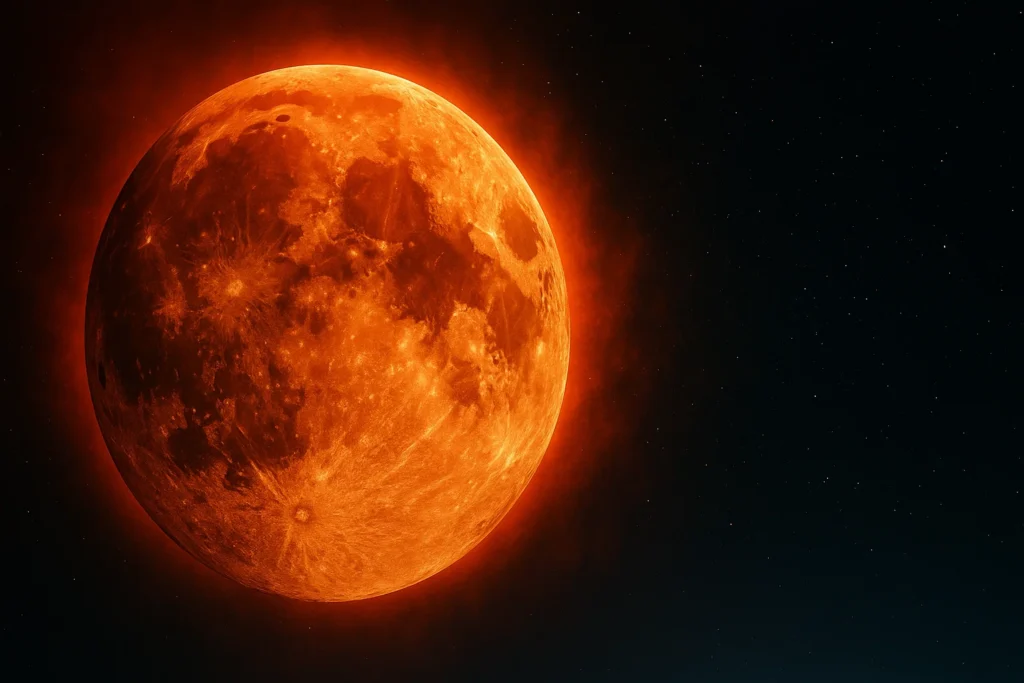

A lunar eclipse is one of the most fascinating sky events. Unlike a solar eclipse, which is dangerous to watch with the naked eye, a lunar eclipse is completely safe and can be enjoyed without any equipment. During the event, many people notice something strange: the Moon does not disappear when it passes into Earth’s shadow. Instead, it often turns a deep red or copper color. This has led people for centuries to call it a “blood moon.”
But why does this happen? To understand, let’s break it down step by step in simple language.
What Is a Lunar Eclipse?
A lunar eclipse happens when the Earth comes directly between the Sun and the Moon. The Earth blocks sunlight from reaching the Moon, and its shadow falls on the Moon.
There are three main types:
- Penumbral Eclipse: The Moon passes through the lighter part of Earth’s shadow (the penumbra). The change is very subtle, and the Moon just looks a little dimmer.
- Partial Eclipse: A part of the Moon enters the darkest part of Earth’s shadow (the umbra). You can see a dark bite taken out of the Moon.
- Total Eclipse: The whole Moon is inside the umbra. Instead of disappearing completely, it glows red. This is the event most people call the “blood moon.”
Why Doesn’t the Moon Go Completely Dark?
You might think that when Earth blocks the Sun’s light, the Moon should vanish completely into darkness. But that doesn’t happen. The reason is that some sunlight still reaches the Moon — not directly, but after being bent around Earth’s atmosphere.
Earth’s atmosphere acts like a giant lens. It bends and filters sunlight. The straight paths of light are blocked by Earth, but the curved, refracted rays manage to reach the Moon. These rays are not white anymore; they are mostly red or orange.
This is the light that paints the Moon red during an eclipse.
The Science of the Red Color
The red color comes from a process called Rayleigh scattering.
Here’s how it works:
- Sunlight looks white, but it is actually a mix of all colors (like a rainbow).
- When light enters Earth’s atmosphere, shorter wavelengths like blue and violet scatter in all directions. That’s why the sky looks blue during the day.
- The longer wavelengths, such as red and orange, pass through more easily.
- During a lunar eclipse, this red light bends around the edges of Earth and falls on the Moon’s surface.
So, when you see a red Moon, you are actually seeing all the world’s sunrises and sunsets projected onto the Moon.
Why Does the Shade of Red Change?
Not every lunar eclipse looks the same. Sometimes the Moon appears bright copper red, other times it looks dark brown or even almost black. The color depends on conditions in Earth’s atmosphere at that moment.
Factors include:
- Dust and Pollution: If the atmosphere has lots of dust or smoke (from volcanic eruptions, wildfires, or pollution), it blocks more light. The Moon looks darker.
- Weather Conditions: Clear air allows more red light to pass through, making the Moon appear brighter.
- Altitude of the Moon: The higher the Moon is in the sky during the eclipse, the brighter it looks. Near the horizon, more atmosphere blocks the light, making it dimmer.
Astronomers even use something called the Danjon Scale to measure the brightness of eclipses, from very dark (L=0) to bright copper red (L=4).
Historical Beliefs About the Blood Moon
Before science explained the phenomenon, many cultures gave mystical meanings to the red Moon.
- Ancient Mesopotamia: People thought a blood moon was a warning of danger to the king.
- Inca Civilization: They believed a jaguar was attacking and eating the Moon, and they would make loud noises to scare it away.
- Medieval Europe: A red Moon was often linked to war, plague, or bad omens.
- Religious Texts: Some traditions describe the Moon turning to blood as a sign of important events or the end times.
Today, we know the cause is natural and not a supernatural warning, but the beauty and mystery of the red Moon still inspire myths and stories.
Why Is It Safe to Watch a Lunar Eclipse?
Unlike a solar eclipse, a lunar eclipse does not involve looking directly at the Sun. The Moon only reflects sunlight, and during an eclipse, it is dimmer than usual. That means you can look at it with your eyes, binoculars, or telescopes safely, without any special glasses.
In fact, a lunar eclipse is one of the easiest and safest astronomy events to watch. All you need is a clear night sky.
How Often Do Lunar Eclipses Happen?
Lunar eclipses are more common than solar eclipses. On average, there are about two to five eclipses (solar and lunar combined) every year. But not every eclipse is total, and not every one is visible from your location.
A total lunar eclipse can be seen from anywhere on Earth where the Moon is above the horizon at that time. This makes it more widely visible than a solar eclipse, which can only be seen along a narrow path.
The Blood Moon and Modern Science
Even though we no longer see it as a bad omen, scientists still study lunar eclipses carefully. They use them to:
- Study Earth’s atmosphere: The color and brightness of the eclipse reveal how much dust or pollution is in the air.
- Understand climate events: After large volcanic eruptions, lunar eclipses tend to look darker.
- Inspire astronomy: For many people, watching a blood moon sparks curiosity about space and science.
Final Thoughts
The Moon turning red during a lunar eclipse is one of nature’s most beautiful illusions. The sight is caused by Earth’s atmosphere bending sunlight, filtering out blue colors, and sending the remaining red glow to the Moon. Instead of disappearing in darkness, the Moon becomes a glowing red lantern in the night sky.
So, the next time you see a blood moon, remember: you are actually looking at the combined light of millions of sunsets and sunrises happening all around the Earth at that very moment. It is a reminder of how our planet, atmosphere, and the Moon are all connected in the grand dance of the cosmos.
For the Best Money saving Online shopping deals, JOIN our Telegram Channel https://t.me/crazziee_stuff1