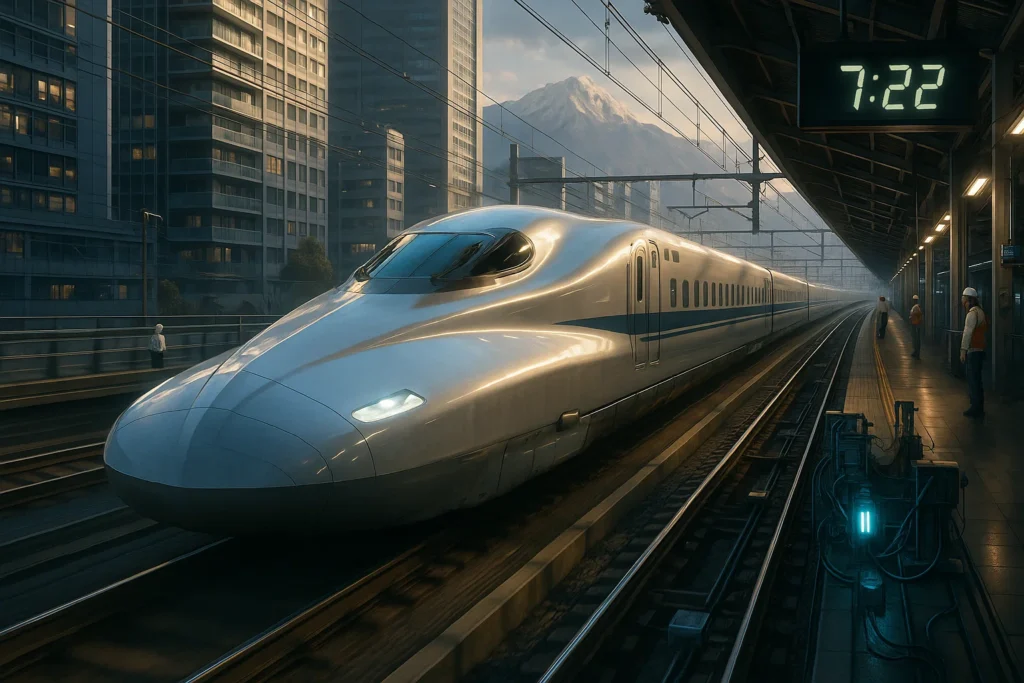

Japan’s bullet trains, known as Shinkansen, are among the fastest, safest, and most punctual trains in the world. They can travel at speeds exceeding 320 kilometers per hour (200 mph)—yet they almost never run late. Even a delay of 30 seconds is treated as a serious issue. But how is such incredible precision and reliability possible? The secret lies in a combination of cutting-edge engineering, meticulous design, and a national culture of discipline.
Let’s uncover the hidden science and engineering miracles that keep Japan’s bullet trains on track—literally and figuratively.
1. The Birth of the Bullet Train Revolution
The first Shinkansen line began operating in 1964, just before the Tokyo Olympics. Japan needed a fast, efficient, and dependable transport system to connect its major cities. Since then, the Shinkansen has transformed modern rail travel, becoming a symbol of engineering excellence and national pride. Over the decades, Japan has continually improved its trains with new technologies, materials, and designs to make them faster, safer, and more punctual.
2. Dedicated Tracks — No Shared Railways
One of the biggest reasons Japan’s bullet trains never run late is that they operate on exclusive, dedicated rail lines—separate from regular passenger and freight trains. This eliminates delays caused by congestion or traffic conflicts that plague other rail systems worldwide.
Each Shinkansen route is designed with gentle curves and gradual slopes, allowing trains to maintain high speed without slowing down. These tracks are also continuously welded, minimizing vibrations and noise, which not only improves comfort but also reduces wear on train parts.
3. Precision Scheduling and Time Management
Every Shinkansen train follows a timetable calculated to the second, not the minute. Trains are dispatched, cleaned, boarded, and departed in an astonishingly synchronized routine.
- Cleaning crews, known as the “seven-minute miracle team,” completely clean and prepare an entire 16-car train in just seven minutes.
- Departure announcements, door closures, and acceleration are perfectly timed using automated systems and synchronized station clocks.
Even minor deviations—like a few seconds’ delay—trigger immediate coordination between train controllers and operators to recover lost time.
4. Aerodynamic Design and Advanced Materials
The sleek, elongated nose of the bullet train isn’t just for aesthetics—it’s a masterpiece of aerodynamics. Engineers designed it to reduce air resistance, drag, and tunnel boom, a loud pressure wave that occurs when trains enter tunnels at high speed.
The latest models, such as the N700S series, use lightweight aluminum alloys and active suspension systems to ensure smoother, more stable rides. These innovations allow the train to maintain high speed even on curved tracks while keeping passengers comfortable.
5. Earthquake and Safety Technology
Japan is one of the most earthquake-prone countries in the world. To counter this, every bullet train line is connected to an early earthquake detection network.
When seismic sensors detect tremors, they instantly send signals to cut power and slow trains safely before the shockwaves reach the area. This system has prevented major accidents during earthquakes, making the Shinkansen not just fast, but one of the safest transportation systems on Earth.
6. Human Precision Meets Machine Intelligence
While automation plays a key role, human precision and discipline are equally vital. Shinkansen drivers and crew undergo rigorous training, learning to operate with pinpoint accuracy. Many drivers are trained to stop trains at platforms within a margin of less than 50 centimeters—consistently.
AI-driven systems now assist operators by analyzing track conditions, weather, and air pressure, adjusting speed and braking patterns automatically. The partnership between humans and machines ensures maximum efficiency without compromising safety.
7. Maintenance Culture and Continuous Improvement
Every night, when operations end, maintenance crews inspect the tracks, electrical systems, and train components. Even the smallest vibrations or sound anomalies are recorded and fixed before the next day’s service.
This proactive approach—called “kaizen,” meaning continuous improvement—is a cornerstone of Japanese engineering philosophy. It ensures that no potential issue grows into a problem that could cause delays.
Final Thoughts
Japan’s bullet trains are not just fast machines—they are symbols of precision, reliability, and human excellence. Behind their flawless timing lies a blend of aerodynamic design, world-class maintenance, earthquake safety systems, and a culture that values perfection down to the last second.
When you ride the Shinkansen, you’re not just traveling between cities—you’re experiencing one of the greatest engineering miracles of the modern world, a perfect balance of speed, safety, and discipline that few countries have ever achieved.
For the Best Money saving Online shopping deals, JOIN our Telegram Channel https://t.me/crazziee_stuff1