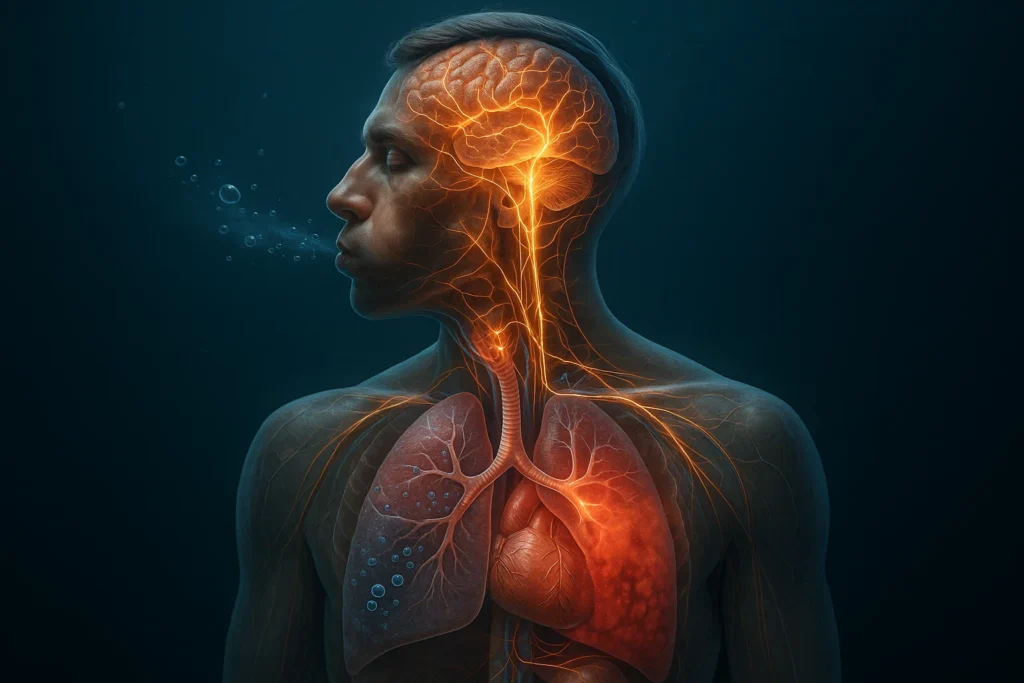

Holding your breath might seem simple — a test of willpower or a playful challenge — but inside your body, it triggers an extraordinary chain of reactions. Every organ, cell, and nerve system begins working in emergency mode to protect the brain and vital organs from oxygen shortage.
But what exactly happens inside your body when you hold your breath for too long? And how does your brain know when it’s time to take a breath again? Let’s explore the fascinating biology behind this life-preserving process.
1. The Moment You Stop Breathing
The instant you stop breathing, your lungs stop exchanging gases — no oxygen (O₂) is entering, and no carbon dioxide (CO₂) is leaving. The oxygen in your lungs, blood, and tissues becomes the only supply your body has left.
At first, nothing feels wrong because your blood already contains enough oxygen to fuel the body for several seconds. But as CO₂ starts to build up, your brain begins to sense that something is off.
2. The Rising Carbon Dioxide Alarm
The main reason you feel the urge to breathe isn’t actually due to low oxygen — it’s because of rising carbon dioxide levels in your blood.
As your cells continue to burn oxygen for energy, they release CO₂ as a waste product. When you stop breathing, CO₂ accumulates in your bloodstream, forming carbonic acid, which lowers the pH of your blood.
Your brain’s medulla oblongata and pons — the centers that control breathing — are extremely sensitive to these pH changes. When they detect that the blood has become too acidic, they interpret it as a sign of oxygen shortage and send a powerful signal: “Breathe now.”
That’s the uncomfortable, almost painful urge you feel when you’ve been holding your breath too long.
3. Oxygen Drops, Body Prioritizes Survival
As time passes, oxygen levels start falling. The normal oxygen saturation in your blood is around 95–100%, but during extended breath-holding, it can drop below 90%, leading to a state called hypoxia.
Your body now activates its survival hierarchy:
- Blood vessels in your limbs constrict, redirecting blood flow toward your brain and heart.
- Your heart rate slows down, reducing oxygen consumption (a reflex similar to what’s seen in deep-sea divers).
- Non-essential organs, like the stomach and skin, temporarily receive less blood.
This protective mechanism ensures that your most vital organs — particularly the brain — get as much oxygen as possible for as long as possible.
4. Brain’s Emergency Signal System
When oxygen levels continue to drop, the brain enters a critical phase. Specialized neurons, called chemoreceptors, constantly monitor oxygen and CO₂ concentrations in the blood.
If the oxygen level falls too low, these sensors send rapid emergency signals through the autonomic nervous system. This triggers several automatic reactions:
- The diaphragm and chest muscles start contracting involuntarily — that’s the body’s last effort to force you to breathe.
- If you resist too long, the brain may temporarily override consciousness, causing you to faint.
This is the body’s ultimate failsafe. By losing consciousness, your reflex breathing takes over, ensuring that you inhale before serious brain damage can occur.
5. The Point of Danger
If you still somehow don’t breathe (for example, underwater), oxygen levels keep dropping. Below 60% oxygen saturation, brain cells begin to malfunction.
- Within 30–90 seconds, coordination and vision blur.
- After 2–3 minutes, brain cells start dying from lack of oxygen.
- Beyond 5 minutes, permanent brain injury or death can occur unless oxygen is restored.
Professional free divers train their bodies to tolerate higher CO₂ levels and lower oxygen levels, but even they risk blackouts if they push beyond safe limits.
6. The Aftermath: Recovery Breathing
When you finally take that desperate breath, air rushes into your lungs, oxygen floods the bloodstream, and carbon dioxide levels quickly fall. Within seconds, your brain chemistry stabilizes, and your heart rate normalizes.
That first deep breath feels incredibly satisfying because your body is flooding every cell with much-needed oxygen, restoring balance after a few minutes of internal chaos.
7. Why This Reflex Is So Powerful
Humans can’t consciously override their breathing reflex for long because it’s controlled by the autonomic nervous system — the same system that keeps your heart beating and digestion working without you thinking about it.
This design ensures survival. Even if your conscious mind wants to hold your breath, your body will always fight back to protect itself from suffocation.
Final Thoughts
Holding your breath sets off a silent battle inside your body — between willpower and survival instincts. As oxygen runs low and carbon dioxide builds up, your brain’s emergency systems take control, forcing you to breathe before permanent damage occurs.
It’s a reminder of how perfectly tuned the human body is. Every breath you take happens because your brain, heart, and lungs work together in constant communication, ensuring life continues — even when you try to stop it.
For the Best Money saving Online shopping deals, JOIN our Telegram Channel https://t.me/crazziee_stuff1