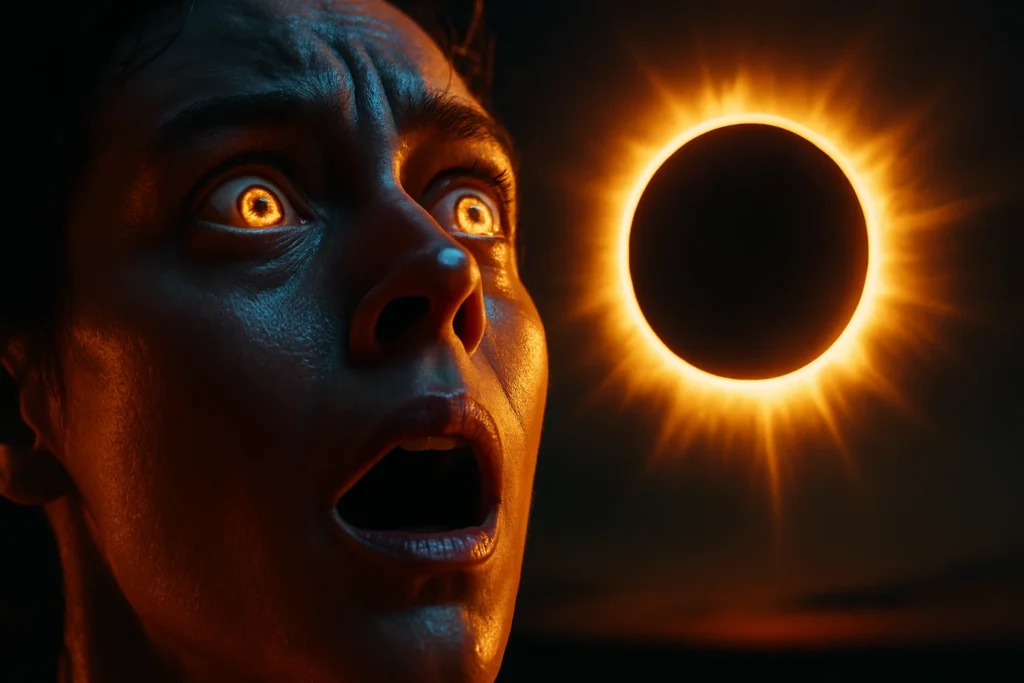

A solar eclipse is one of the most beautiful sights in nature. The Moon moves in front of the Sun, and for a few minutes, day turns into night. Many people want to watch this rare event with their own eyes. But there is one big danger: looking directly at the Sun without protection can permanently damage your eyes.
Let’s break down exactly why this happens, what kind of damage it causes, and how you can watch an eclipse safely.
Why the Sun Is Dangerous for Your Eyes
The Sun is incredibly bright. Even though it is 150 million kilometers away, its light is strong enough to burn your skin and create daylight on Earth. Our eyes are not designed to look at such intense light directly.
Normally, we never stare at the Sun because it hurts immediately and makes us turn away. But during a solar eclipse, the Sun is partly covered by the Moon, so the brightness is reduced. This makes people think it is safe to look — but in reality, it is even more dangerous. The reduced brightness tricks the brain, so you can look longer without pain, while the hidden damage is still happening inside your eyes.
What Happens Inside Your Eyes
The back part of your eye is called the retina. This is like the camera sensor that collects light and sends signals to your brain. In the very center of the retina is the fovea, which gives you sharp, detailed vision.
When you look at the Sun:
- Light is focused by your lens directly onto the retina.
- The intense energy burns and damages the cells, especially in the fovea.
- The damage happens through both heat (burning) and chemical reactions caused by light.
This condition is called solar retinopathy.
The scary part is that your retina has no pain nerves. That means you don’t feel burning or damage while it happens. You may think everything is fine — until hours later when vision problems begin.
Symptoms of Solar Retinopathy
If someone looks at the Sun without proper protection, they may later notice:
- Blurry central vision (words look fuzzy when reading).
- A dark or gray spot in the middle of vision.
- Distorted lines (straight lines look bent or wavy).
- Colors that look faded or washed out.
- Sensitivity to light.
Symptoms usually appear 4 to 12 hours later, not immediately. This delay is why many people are surprised the next day when they wake up and cannot see clearly.
How Fast Can Damage Happen?
You might think, “If I only glance for a second, I’ll be fine.” But even short glances are risky.
- Without magnification: A few seconds of direct viewing may be enough to cause harm.
- With binoculars, a camera lens, or a telescope: Damage can happen instantly, in less than a second, because these devices concentrate sunlight like a magnifying glass.
In other words: even “just a quick look” is not safe.
Real-Life Cases
Doctors have studied many cases of solar retinopathy after eclipses around the world. For example:
- In past eclipses, hundreds of people went to hospitals complaining of blurred vision after watching without protection.
- Some of them recovered after weeks or months.
- Others had permanent blind spots in their central vision that never healed.
This proves the risk is real — it is not just a warning, but something that has happened to many people.
Can the Damage Heal?
The outcome depends on how long and how strong the exposure was.
- Mild cases: Vision may slowly improve over weeks or months.
- Severe cases: The blind spot or blurred area can stay forever.
There is no medicine or surgery that can fully repair destroyed retina cells. That’s why prevention is the only safe option.
Why Totality Is Different
During a total solar eclipse, when the Sun is 100% covered by the Moon, it is safe to look directly at the sky for that short period. The Sun’s bright disc is completely blocked, and only the outer corona (the glowing halo) is visible.
But this safe period lasts only for a few minutes, and only in areas where the eclipse is total. The moment even a tiny piece of the Sun reappears, it becomes dangerous again. People who are not in the path of totality — who only see a partial eclipse — must never look without protection.
How to Watch an Eclipse Safely
If you want to enjoy the beauty of an eclipse without risking blindness, here are the safe methods:
- Eclipse Glasses:
- Use only glasses that meet the safety standard called ISO 12312-2.
- Regular sunglasses are not safe, no matter how dark they are.
- Solar Filters for Cameras or Telescopes:
- If you want to take photos or use binoculars, you must use proper solar filters on the front of the lens.
- Never point a camera or telescope at the Sun without a certified solar filter.
- Pinhole Projector:
- You can make a simple viewer by poking a small hole in a card and letting sunlight pass through it onto the ground or another card.
- This projects an image of the Sun safely.
- Other Projection Methods:
- A colander, tree leaves, or even your hands can create small shadow projections of the Sun’s crescent shape.
These methods allow you to watch the eclipse without ever looking at the Sun directly.
What to Do If You Looked Without Glasses
If you did accidentally look at the Sun and later notice blurred vision or a dark spot:
- Don’t panic, but take it seriously.
- Avoid staring at bright light for a while.
- See an eye doctor (ophthalmologist) as soon as possible. They can examine your retina using special scans to check for damage.
Even if the damage is permanent, early medical advice is important to protect your remaining vision and avoid more harm.
Final Thoughts
A solar eclipse is one of the most magical natural events. But it comes with a hidden danger that many people underestimate. Looking at the Sun without protection, even for a few seconds, can scar your vision for life.
The truth is simple:
- Your eyes cannot feel pain from solar damage.
- Symptoms may show up hours later.
- Once your retina is burned, there is no easy cure.
So if you want to enjoy the eclipse, do it the smart way — with certified eclipse glasses, safe filters, or indirect viewing. Protecting your eyes is not just advice; it is the difference between experiencing the wonder of the universe and living with permanent vision loss.
For the Best Money saving Online shopping deals, JOIN our Telegram Channel https://t.me/crazziee_stuff1