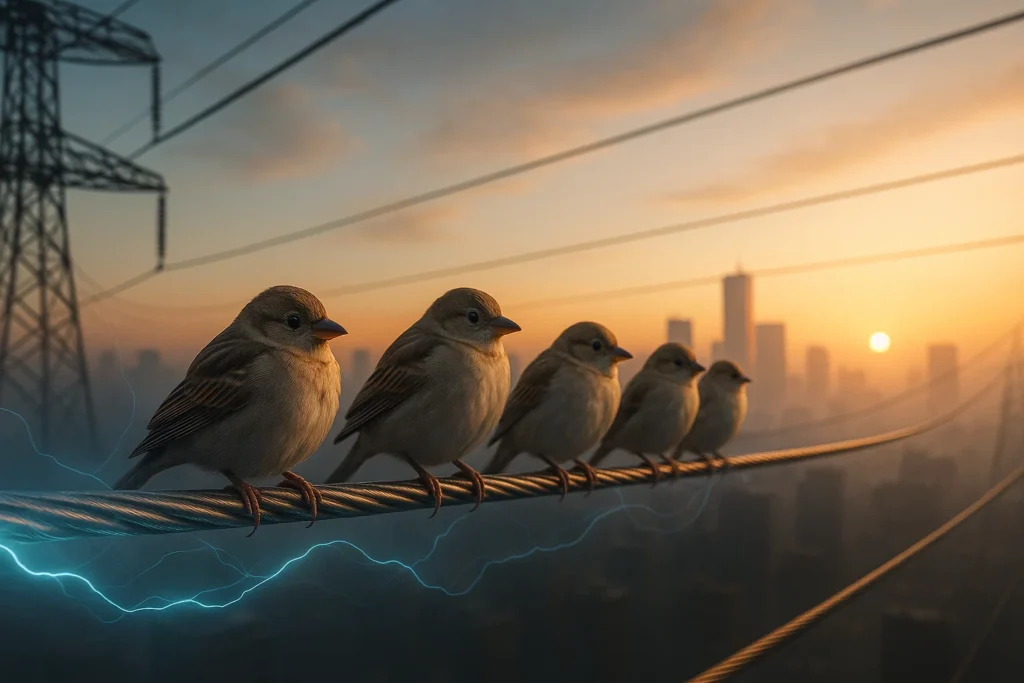

If you walk outside and look at electric poles, you often see birds sitting comfortably on wires. They perch, rest, and even clean their feathers, showing no fear of electricity. But electricity is dangerous to humans—so why don’t birds get shocked or injured when they sit on these high-voltage wires?
The answer lies in the laws of electricity, physics, and biology. Birds are safe because of how electric current flows and the way their bodies interact with the wire. Let’s explore this fascinating phenomenon in detail.
What Is Electricity?
Before we understand birds and wires, we need to know what electricity is and how it flows.
- Electricity is the movement of electric charge (electrons) through a conductor, like copper wires.
- Current always flows from a higher voltage (more electrical energy) to a lower voltage (less electrical energy).
- To complete the flow, electricity needs a path to the ground (earth) or to another point of lower potential.
Why Birds Don’t Get Shocked
Birds are safe on wires because of one main principle of electricity:
👉 Electric current only flows when there is a difference in voltage (potential difference) between two points.
Case 1: Bird on a Single Wire
- When a bird sits with both feet on the same wire, its entire body is at the same electrical potential.
- There is no voltage difference between its two feet.
- Since current flows only when there is a voltage difference, electricity has no reason to pass through the bird’s body.
- As a result, the bird remains safe.
Case 2: Bird Touching Two Wires
- If a bird spreads its wings and accidentally touches two wires at different voltages, it creates a path for current.
- The voltage difference between the two wires pushes electricity through the bird’s body.
- This can cause electrocution, injury, or death.
Case 3: Bird Touching Wire and Ground
- If a bird touches the wire and a grounded object (like a pole, transformer, or tree branch), it creates a path for current to flow to the ground.
- In this case, the bird would get a dangerous shock.
Real-Life Example for Better Understanding
Imagine standing on the ground with one hand touching a live electric wire:
- Your feet are at zero volts (ground).
- The wire is at high voltage.
- Electricity flows through your body into the ground → you get shocked.
Now imagine standing on a giant rubber ball (not touching the ground) and then touching the wire:
- Your whole body is at the same voltage as the wire.
- There is no potential difference.
- Electricity has no reason to flow through you → you remain safe, just like a bird.
The Role of Resistance
Birds are also safe because of electrical resistance:
- The bird’s body has much higher resistance compared to the copper or aluminum wire.
- Electricity always chooses the easiest path with least resistance.
- Since the wire is a much better conductor, almost all electricity keeps flowing through it instead of through the bird.
Why Birds Choose Wires to Sit
Apart from safety, there are simple reasons why birds prefer to rest on wires:
- Height Advantage: Wires are elevated, keeping birds safe from predators.
- Warmth: Electric wires (especially high-voltage ones) can become slightly warm, providing comfort.
- Resting Spot: Wires run across cities and villages, giving birds easy places to perch.
- Social Behavior: Birds often sit in groups on wires as part of flocking behavior.
Can Birds Ever Get Shocked?
Yes, birds can get electrocuted in certain cases:
- Large Birds and Wing Span
- Birds like eagles or storks with wide wingspans may accidentally touch two wires at different voltages.
- This creates a deadly current path.
- Contact With Metal Structures
- If a bird touches a live wire and a grounded pole at the same time, it can get shocked.
- Wet Conditions
- Water is a good conductor.
- If a bird is wet and touches two conductors, the risk of electrocution increases.
How Humans Stay Safe With Wires
Humans are much more at risk around electricity because:
- We stand on the ground, which makes us natural conductors to earth.
- If we touch a wire, current immediately flows from the wire → through our body → into the ground.
- That’s why linemen use protective gear, insulated gloves, and sometimes even perch on insulated platforms when repairing wires.
Lessons From Birds and Electricity
The way birds avoid shock teaches us several important lessons about electricity:
- Current flows only when there is a potential difference.
- Touching one live wire alone may not shock you if you are completely insulated from the ground—but it’s extremely dangerous for humans to try.
- Birds are safe only because of physics, not because they are immune to electricity.
Key Points to Remember
- Birds don’t get shocked on a single wire because both feet are at the same voltage.
- Shock happens only when there is a voltage difference and a path for current.
- Birds can die if they touch two wires or a wire and the ground at the same time.
- Electricity always takes the easiest path (least resistance), usually the wire—not the bird.
Conclusion
Birds sitting on electric wires may seem like a mystery, but the explanation lies in the science of electricity. They remain safe because their bodies are at the same potential when perched on a single wire, meaning there’s no voltage difference to drive current through them. However, if they touch two wires or a grounded object, they can be electrocuted.
So next time you see a row of birds resting calmly on a power line, remember—it’s not magic. It’s simple physics, potential difference, and resistance working together to keep them safe.
For the Best Money saving Online shopping deals, JOIN our Telegram Channel https://t.me/crazziee_stuff1