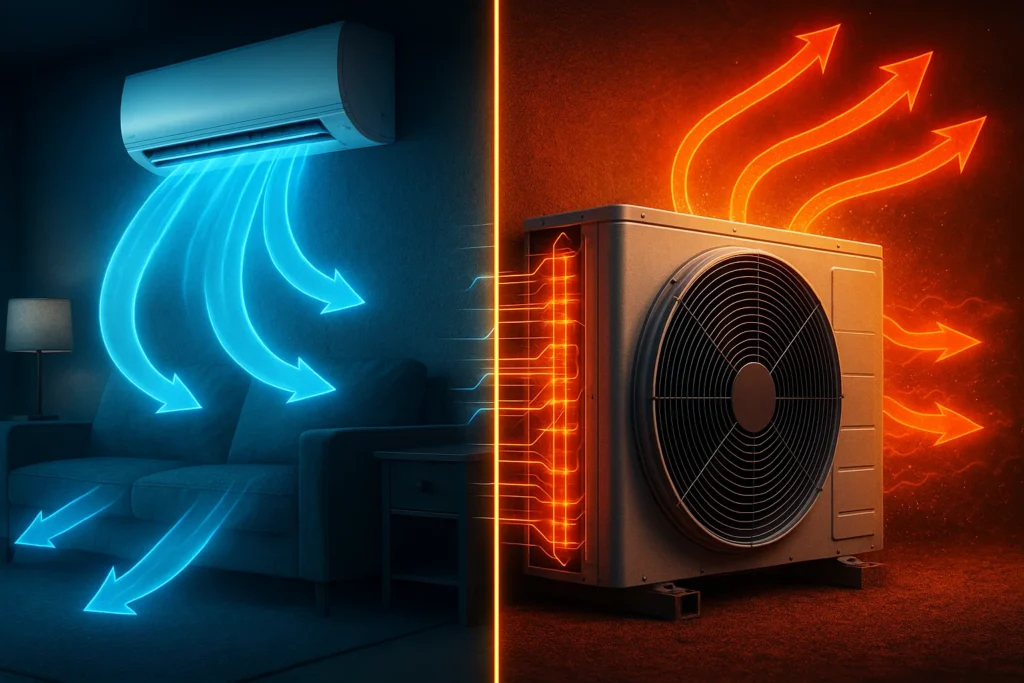

When you walk into a room on a hot summer day and feel the refreshing cool air from an air conditioner (AC), it can feel almost magical. Many people think air conditioners “create cold air,” but the truth is very different. Air conditioners do not make cold air out of nothing. Instead, they remove the heat from inside a room and push it outside, while circulating the cooler air back into the room. This process is based on science, engineering, and the clever use of refrigerants.
In this article, we’ll break down how ACs work in simple terms, how they move heat, and why they recycle air.
The Basic Idea
- Air conditioners don’t add coldness; they subtract heat.
- Heat is transferred from the warm air inside the room to the outside environment.
- The “cold air” you feel is simply air that has been cooled by removing its heat energy.
Think of it like a sponge: the AC “soaks up” the heat from your room and then “squeezes it out” outside.
The Main Components of an Air Conditioner
To understand how cooling works, let’s look at the main parts of an air conditioner:
1. Evaporator Coil (Inside the Room)
- This part is located in the indoor unit.
- Warm air from the room passes over the coil filled with a liquid called refrigerant.
- The refrigerant absorbs heat from the air, cooling it down.
- The cooler air is then blown back into the room.
2. Compressor (Outside Unit)
- The compressor is the “heart” of the AC system.
- It squeezes the refrigerant, raising its pressure and temperature.
- This helps move heat from inside the room to the outside.
3. Condenser Coil (Outside Unit)
- The hot refrigerant gas from the compressor passes through the condenser coil.
- A fan blows outdoor air across the coil, releasing the heat to the outside environment.
- The refrigerant cools down and turns back into a liquid.
4. Expansion Valve
- Before the refrigerant returns to the evaporator coil, it passes through an expansion valve.
- This valve lowers the pressure of the refrigerant, making it cold again.
- This cycle allows the refrigerant to keep absorbing heat from your room.
Step-by-Step Process of Cooling
- Warm air intake:
- The indoor unit’s fan pulls warm room air toward the evaporator coil.
- Heat absorption:
- The refrigerant inside the coil absorbs heat from the air.
- This makes the refrigerant warmer while the air becomes cooler.
- Cool air circulation:
- The cooled air is blown back into the room through vents.
- This is why you feel cold air coming from the AC.
- Heat transfer outside:
- The warm refrigerant flows to the compressor, then to the condenser coil outside.
- A fan blows outdoor air across the coil, and the heat is released outside.
- Refrigerant reset:
- After releasing heat, the refrigerant cools down and is sent back to the evaporator coil to repeat the process.
- This continuous cycle makes sure your room stays cool as long as the AC is running.
Why Air Conditioners Recycle Room Air
Many people believe ACs bring in fresh air from outside, but that’s not usually true. In most cases, they recycle the same air inside your room by cooling it again and again.
Reasons why:
- Efficiency: Cooling outside hot air would take too much energy.
- Control: Recycling air helps maintain a stable temperature.
- Moisture Removal: ACs also remove humidity (moisture) from the air, which works better if the same air is processed repeatedly.
However, some advanced systems do allow fresh outdoor air to mix in small amounts for ventilation.
The Role of Refrigerant
Refrigerant is a special chemical fluid that changes easily between liquid and gas. This property makes it perfect for absorbing and releasing heat.
- Inside the room, it absorbs heat and evaporates into gas.
- Outside, it releases heat and condenses back into liquid.
- This cycle keeps repeating without the refrigerant being “used up.”
Modern ACs use environmentally safer refrigerants compared to older harmful gases like CFCs.
Common Misunderstandings About ACs
- “AC creates cold air.”
- Wrong. It only removes heat from your room.
- “AC brings in fresh air.”
- Wrong. Most systems recycle indoor air.
- “Lowering the temperature faster cools the room quicker.”
- Not true. Setting your AC to 16°C doesn’t cool faster than 24°C; it only makes the AC work longer.
Benefits of Air Conditioners
- Comfort: Keeps rooms cool and pleasant during hot weather.
- Humidity Control: Reduces moisture in the air, preventing mold growth.
- Better Sleep: Cool temperatures help people sleep more comfortably.
- Protects Electronics: Prevents overheating of devices like computers.
Downsides of Air Conditioners
- High Energy Use: ACs consume a lot of electricity, leading to higher bills.
- Environmental Impact: They release heat into the outside environment and can contribute to global warming if not energy-efficient.
- Maintenance Needs: Filters and coils must be cleaned regularly to avoid poor performance.
- Health Issues: Poorly maintained ACs can spread dust, bacteria, and cause dry skin.
The Future of Air Conditioning
Technology is evolving to make air conditioners more:
- Energy-efficient: Using less power for the same cooling.
- Eco-friendly: Using refrigerants that do not harm the ozone layer.
- Smart: Controlled with phones, adjusting automatically to save energy.
- Sustainable: Some new models use solar power to reduce electricity costs.
Conclusion
Air conditioners are not magic machines that “create cold air.” Instead, they work by removing heat from your room and transferring it outside through a cycle of refrigerant, compressors, and coils. The cool air you feel is simply recycled room air that has had its heat removed.
By understanding how they actually work, we can use them more efficiently, maintain them better, and appreciate the science behind the comfort they bring.
For the Best Money saving Online shopping deals, JOIN our Telegram Channel https://t.me/crazziee_stuff1