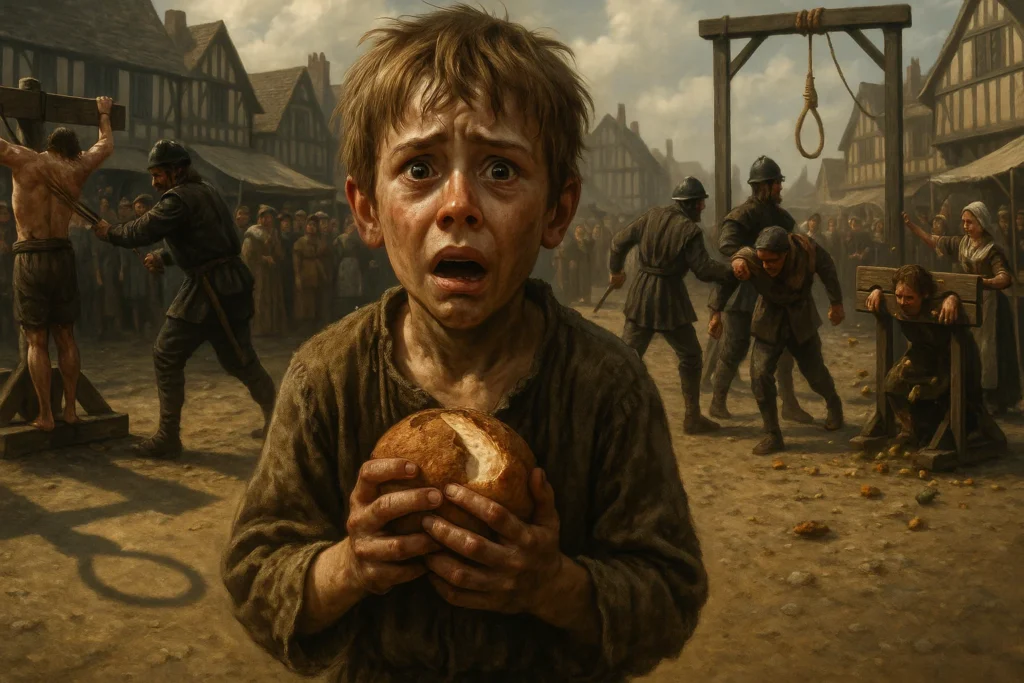

When we think about crime and punishment today, most people imagine prison sentences, fines, or community service. But in the 16th century, especially in England, the justice system was far more brutal. Even the smallest crimes, such as stealing a loaf of bread, could lead to horrifying punishments that seem unimaginable to us now. To understand why such harsh penalties existed, we need to look closely at the laws, the society, and the mindset of people living during that time.
Life in 16th-Century England
The 1500s were a time of great change in England. This was the period of the Tudor monarchs, starting with Henry VII, followed by Henry VIII, Edward VI, Mary I, and Elizabeth I. Society was divided sharply between the rich and the poor. The wealthy landowners, nobles, and royals lived in luxury, while peasants and common people often struggled just to survive.
Food shortages were common. Harvests depended heavily on weather, and when crops failed, famine spread. Bread was the most important food for poor people, and without it, families went hungry. At the same time, unemployment was widespread, and wages were low. With no proper welfare system, desperate people often turned to theft just to stay alive.
But the law did not treat theft as a minor act of survival. Instead, it was seen as a direct threat to order and authority. Stealing a loaf of bread, no matter how small the value, was treated as a serious crime against society.
The Harsh Legal System
The 16th-century justice system was based on fear and punishment rather than rehabilitation. The ruling class believed that the only way to control the poor was through terror. Laws were created not to protect the weak but to protect the property of the rich.
Theft of even the smallest item could be classified as a felony, which was a crime punishable by death. There was very little difference in the law between stealing a loaf of bread and committing murder. The punishment might be the same: execution.
This approach was part of what historians call the “Bloody Code.” Although it became more notorious in the 17th and 18th centuries, its roots were already present in Tudor England. The idea was simple: harsh penalties would discourage people from committing crimes. But in practice, desperation often pushed people to risk death for survival.
Common Punishments for Theft
If someone was caught stealing bread in 16th-century England, several brutal punishments could follow:
1. Public Whipping
One of the most common punishments for petty theft was whipping. The thief would be tied to a post in the town square and beaten with a whip in front of a crowd. This was meant to shame the criminal and scare others from doing the same. The whippings were often so severe that people fainted or were left with permanent scars.
2. The Stocks or Pillory
Another public punishment involved locking the criminal into wooden devices called stocks or pillories. The thief’s hands, feet, or head would be trapped, leaving them helpless in public view. People passing by would throw rotten food, mud, or even stones at them. The humiliation was sometimes worse than the physical pain.
3. Branding
For repeat offenders, branding with hot irons was common. A thief might have the letter “T” burned into their skin, usually on the hand or forehead. This marked them for life as a criminal and made it nearly impossible to find honest work again.
4. Hanging
For many, stealing bread was not just a whipping offense—it could lead directly to execution. Hanging was the ultimate punishment for theft, and it was shockingly common. Public hangings were staged as entertainment, drawing large crowds. The authorities believed that making executions public would frighten people into obedience.
It may seem unbelievable, but there are historical records of children as young as 10 being hanged for stealing small amounts of food. The law showed little mercy for age or circumstance.
Why So Harsh?
The reason punishments were so extreme was not just cruelty for its own sake. The Tudor government feared disorder above all else. Poverty was widespread, and there were thousands of beggars and vagabonds roaming the countryside. Officials believed that if they showed mercy, theft and rebellion would spiral out of control.
Another reason was the lack of prisons. Unlike today, there were no large prison systems to hold people for long sentences. Jails that did exist were filthy holding cells, not long-term punishment centers. So, the main options were quick and public penalties: whipping, branding, or hanging.
The Role of Religion
Religion also played a role in these punishments. England was a deeply religious society, and theft was seen not only as a crime against property but also as a sin against God. By punishing thieves harshly, rulers believed they were enforcing divine justice. Public executions were often accompanied by sermons reminding the crowd that sin led to damnation.
The Human Cost
The true tragedy of these punishments was that many of the people who suffered were simply hungry. Stealing bread was often not an act of greed but of desperation. Families facing starvation had no choice but to risk the gallows.
Historical accounts describe mothers stealing bread to feed their children and being whipped or hanged as punishment. Instead of addressing the root causes of poverty, the government chose to punish the victims.
The Beginning of Change
By the late 16th century, some voices began to question these cruel punishments. Writers, philosophers, and even some officials argued that killing people for petty theft was inhumane and did little to stop crime. Over the following centuries, the justice system slowly evolved. By the 19th century, Britain began reforming its laws, ending the death penalty for minor thefts and creating prisons for long-term sentences instead.
Looking Back Today
When we look back at the 16th century, it’s shocking to see how harshly people were treated for something as simple as stealing bread. It shows us how different society was and how much progress has been made in human rights and justice. Today, theft is still a crime, but punishments are far more balanced, taking into account the reasons behind the act.
The story of bread theft in Tudor England is a reminder of the cruelty of the past and the importance of compassion in justice. It also shows how poverty and inequality can push people into desperate acts—and how governments that respond only with punishment, not solutions, often create more suffering.
Conclusion
In 16th-century England, stealing bread could cost you your life. Public whippings, humiliating stocks, branding, and even hanging were all possible punishments. These measures were designed to maintain order, but in reality, they punished the poor and desperate more than hardened criminals.
The shocking punishments of the past remind us how vital it is to balance justice with mercy. They also highlight the need for societies to tackle the roots of poverty and hunger rather than punish the victims of it. The next time we hear the phrase “stealing a loaf of bread,” we should remember that for people in Tudor England, it was not just a small crime—it was a matter of life and death.
For the Best Money saving Online shopping deals, JOIN our Telegram Channel https://t.me/crazziee_stuff1