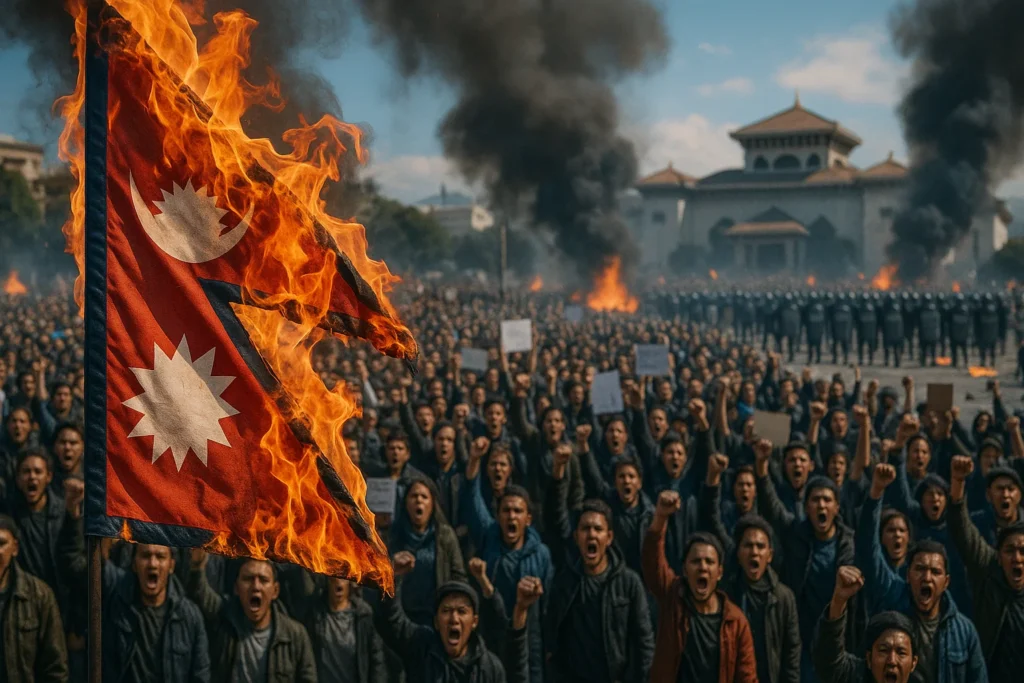

Nepal is going through one of its worst political crises in recent history. What began as anger about a social media ban has grown into mass protests, deaths, injuries, and people openly attacking top leaders. The trust in government has broken badly. Below is the timeline, the causes, what’s happened, who’s involved, and what ordinary people want.
1. When It Began: The Spark
- Date: Early September 2025.
- What triggered it: The government banned 26 social media platforms (including Facebook, Instagram, X, WhatsApp, YouTube) for not registering with new regulations. This happened on September 4, 2025. Many young people saw this as forced censorship.
- Why this mattered: In Nepal a lot of communication, activism, jokes, memes, jobs, and news flow through social media. Blocking these platforms was felt immediately at a personal level — people’s voices were being shut off.
2. Why People Were Already Angry
The social media ban was not the only problem. There had been a build-up of grievances:
- Corruption / Nepotism: Many believe that politicians, ministers, families of leaders, and close business friends get contracts, land, opportunities, and money, and they use government power to protect these benefits. But for common people, basic services (roads, hospitals, schools) are often delayed, mismanaged or of poor quality.
- Economic hardship: Inflation (prices of food, fuel, basic goods) rising, lack of jobs, especially for youth. Many families struggle to pay for daily life.
- Elite lifestyle visible on social media: Young people posted videos/photos of children of political leaders living in big houses, traveling abroad, enjoying luxury, contrasted with their own suffering. That contrast stings.
- Lack of accountability: Years of promises but little visible change. Investigations into corruption often stall; few high officials are punished.
So by September 2025, frustration was overflowing.
3. Protests Spread: From Online to Streets
- Around September 8, 2025, major protests erupted in Kathmandu and other cities. Thousands of mostly young people joined. They carried slogans like “stop corruption, not social media.”
- Protesters tried to storm the Parliament in Kathmandu. Barriers were broken. Some government buildings, including administrative complexes, were attacked or set on fire.
- There was use of force by security: tear gas, water cannons, rubber bullets, and live ammunition in some cases.
4. Bloodshed: Deaths, Injuries, and Shock
- On September 8, 2025, police opened fire on protesters. Nineteen people were killed that day (17 in Kathmandu, 2 in another city). Many were shot in head and chest. Over 100 were injured, including police officers.
- Hospitals were overwhelmed. Many with gunshot wounds; many in serious condition.
- After the first day, the next days saw more unrest. By around September 10-11, total deaths (protesters + security/police) rose to about 30. Injuries counted over 1,000.
- There were reports of people killed even though they were not involved in violent acts; there are questions about whether use of force was excessive or indiscriminate.
5. Violent Scenes: Attack on Officials
- On September 9, 2025, there were shocking videos of Finance Minister Bishnu Prasad Paudel being chased, beaten, kicked by protesters in Kathmandu. He fled; people attacked him physically in the street. This was symbolic of how angry people felt: not just slogans, but physically risking themselves to show they have had enough.
- Former Prime Minister Sher Bahadur Deuba was also reportedly injured amid the clashes.
6. Government’s Response
- The social media ban was lifted after the protests got large and violent. Government said they will restore platforms.
- Prime Minister K.P. Sharma Oli resigned on September 9, 2025. This was seen as one victory for protesters.
- The government declared curfews in Kathmandu and other areas. They deployed more police, and in some reports the Army was involved to help maintain order.
- Home Minister Ramesh Lekhak resigned. There were promises of investigations into the deaths and compensation to families of victims.
7. Dimensions of Corruption & the Elite
While details of exact individuals’ Swiss bank accounts or who has property abroad are still under investigation, what is clearly being claimed by protesters and reported in news:
- Many elites are believed to have wealth overseas or properties abroad, while taxes and government revenue are collected heavily from ordinary people.
- Officials often show luxury lifestyles: big homes, foreign trips, high-end cars, upload pictures of extravagant living. Meanwhile, many citizens struggle for basics.
- People feel there is double standard: laws, regulations, tax evasion seem to be enforced on common people but ignored or bypassed by elites.
8. Scale of the Crisis
- The protest movement has been called “Gen Z protests” because many young people (teenagers, young adults) are leading it. They use social media to organize.
- It is widespread: Kathmandu, Itahari, Pokhara, other cities. Even remote places saw protests.
- Damage: Parliament building damaged, major administrative buildings torched, some political leaders’ residences attacked, luxury hotels impacted.
- Politics in chaos: Government resignations, uncertain leadership, fear of further violence or crackdown.
9. Lives Lost, Family Pain
- Many families lost loved ones—students, young people, unarmed protesters. Some deaths were by gunfire; some by injury from crowd suppression.
- Many are injured — some permanently disabled. Hospitals struggled to treat large numbers. Medical facilities stretched.
- Fear among citizens: people fearing leaving homes, fear of arbitrary actions by security forces, fear for children and youth.
10. Why So Furious
These are the reasons why people lost patience:
- Feeling ignored: That elites don’t suffer as they do.
- That corruption is never punished.
- That government promises ring empty.
- That rising costs of living are not matched by wages or opportunities.
- That the democracy looks like a game where the powerful win, and ordinary people lose.
11. What’s Not Clear Yet
- Which high-level officials precisely are responsible for what corruption; investigations are being promised but not all details are public yet.
- How much money has actually been taken out of Nepal into foreign banks by corrupt officials; some data emerges but full truth is not uncovered.
- Whether after resignations, a truly new government will come, or old guard will reshuffle and behave similarly.
12. What People Want & What Needs to Be Done
Protesters and many citizens are demanding:
- Full accountability: Identify who ordered force, who misused power, who stole public money, and punish them in court.
- Transparency: Public audits of government spending; open books.
- Fair tax system: So that rich and elite pay their share.
- Better public services: Roads, electricity, water, hospital care, education.
- Youth opportunities: Jobs, fair wages, merit-based appointments.
- Free speech protected: No arbitrary bans on social media or news, no censorship.
- Political reform: Reduce patronage, nepotism, misuse of public office for private wealth.
13. What Happens Next
- Political vacuum: With Oli’s resignation, there is uncertainty about who will lead, how stable government will be.
- Possible interim government or early elections demanded.
- Protests may continue until more than just symbolic promises are made.
- International attention: human rights groups are pressing for investigations. International media is watching.
Final Thoughts
Nepal right now is at a breaking point. The current crisis is not only about social media or a single policy: it’s about decades of lost trust, corruption, inequality, and anger that finally exploded. When young people chase a finance minister in the street or break into Parliament, it shows how much ordinary citizens feel powerless.
If Nepal is to heal and move forward, it must do more than change leaders. It must change the system: how power is held, how money is used, how justice is done. Otherwise, the anger will not go away; it will come back again and again.
For the Best Money saving Online shopping deals, JOIN our Telegram Channel https://t.me/crazziee_stuff1