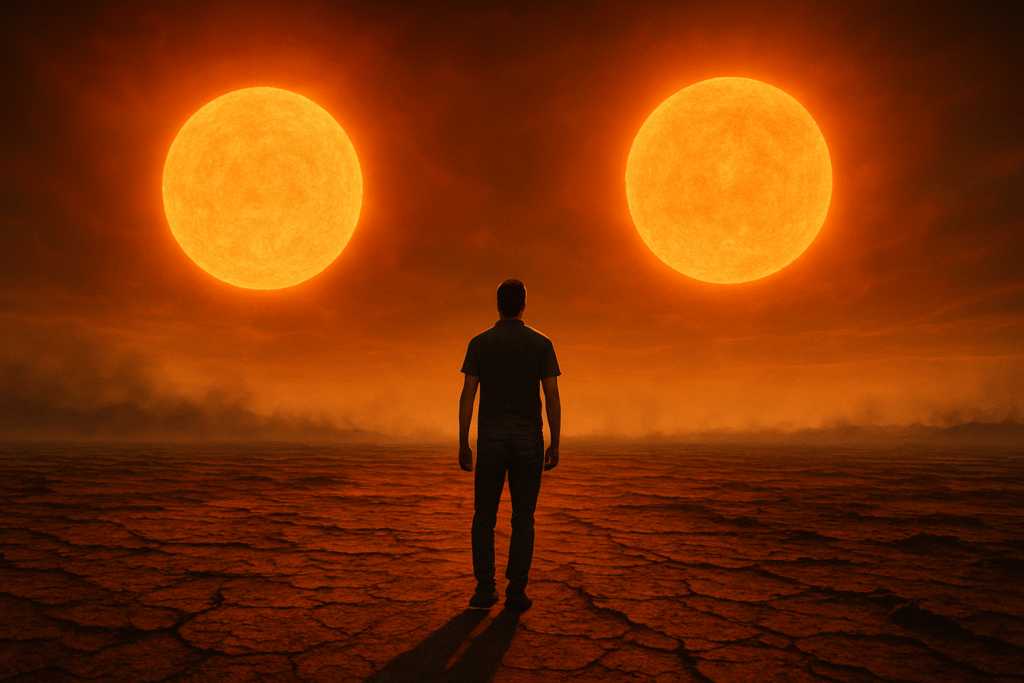

Have you ever considered what life would be like if Earth had two suns rather than one? It sounds like a sci-fi fantasy, but scientists have literally researched this concept. Though some planets are circling two stars, Earth’s two suns would rather cause anarchy than beauty. Let’s analyze what would transpire should our sky suddenly feature two flaming suns.
Could Earth Possess Two Suns?
Surprisingly, yes! Planets known as circumbinary planets circle two stars in other star systems. Kepler-16b was discovered by NASA’s Kepler Space Telescope. Therefore, the notion is more than merely imagination. Earth, however, developed around one sun, precisely calibrated for life as we know it. Add a second sun and everything changes usually for the worse.
- Bye-Bye Constant Orbit
Earth’s current orbit is smooth and consistent, which enables steady temperatures, day-night cycles, and seasonal variations. But with two suns—particularly if they’re near—Earth’s orbit would turn into disorder. The gravitational tug-of-war from both stars might:
Sling Earth into deep space, freezing us permanently.
Crush us in a blazing death on one of the stars.
Trap us in a wobbling orbit to unleash severe weather fluctuations.
None of these results are life-friendly.
- Twice the sunlight, twice the problem
Two suns offers twice the light. Picture a sky nearly always bright, with strong, blinding glare instead of mellow sunrises and sunsets. Shadows would proliferate and become perplexing. Some areas may never see actual darkness, which will upset the sleep patterns of people, animals, and plants. Natural light and dark patterns (circadian rhythms) are vital for our bodies; constant daylight would upset everything. - Extreme Heat Ubiquitous
Two suns would saturate Earth with extra heat. Rapid melting of ice caps would cause sea levels to rise greatly; much of the earth could become an arid desert. Consider deserts taking the place of forests and jungles. Like on Venus, runaway greenhouse effects could transform Earth into a fiery hellscape too hot for most of life to survive. - The atmosphere would become haywire.
More sunshine equals more ultraviolet radiation, which could accelerate damage to the ozone layer of Earth, therefore eliminating our shield from hazardous radiation. Strong storms, hurricanes, and other severe weather occurrences would be churned up by the great heat. Chemical reactions quickening in warmer air might exacerbate pollution and make breathing more difficult. Depending on the way the sun spreads, the skies might remain clouded or show odd hues. - Seasons? Get rid of them.
Seasons arise as Earth turns on its axis as it circles the sun. Two suns may cause seasons to become unpredictable or disappear entirely. Changing unpredictably year after year, you might have frigid winters in summer or extreme heat in winter. This would endanger whole ecosystems, disrupt animal migration and breeding cycles, and destroy crops. - Nights would be uncommon and peculiar.
Dominance may come from constant or almost continual daylight. Nights would be brief and dark; sometimes with twin sunsets blazing in the sky. Many species, including humans, would find it challenging to sleep this way. Astronomers would find challenges as stars disappear behind the brightness, hence stopping stargazing and night sky navigation. - Life as We Know It Might Never Exist
Life might never have developed if Earth had two suns from the start. Early life required stable surroundings, and DNA is susceptible to UV damage. Rapid temperature swings and high radiation could stop the fragile chemistry of life from even starting. Should life develop, it could dwell beneath ground or under water to avoid the severe surface.
Extra: What if the Second Sun was smaller?
Its gravity and light would still upset Earth’s orbit and temperature even if the second sun was a smaller red dwarf star. Thus, any second sun signals trouble regardless of its scale.
Last Thoughts: Lovely but scary
Twin suns may produce breathtaking skies, but the fragile equilibrium of Earth depends on only one constant star. Two suns would cause orbital chaos, extreme heat, constant daylight, and erratic seasons—environments unfavorable for life.
Therefore, appreciate our sole sun next time you savor a sunny day. Though it might appear unremarkable, it is precisely what life on Earth must have to flourish.