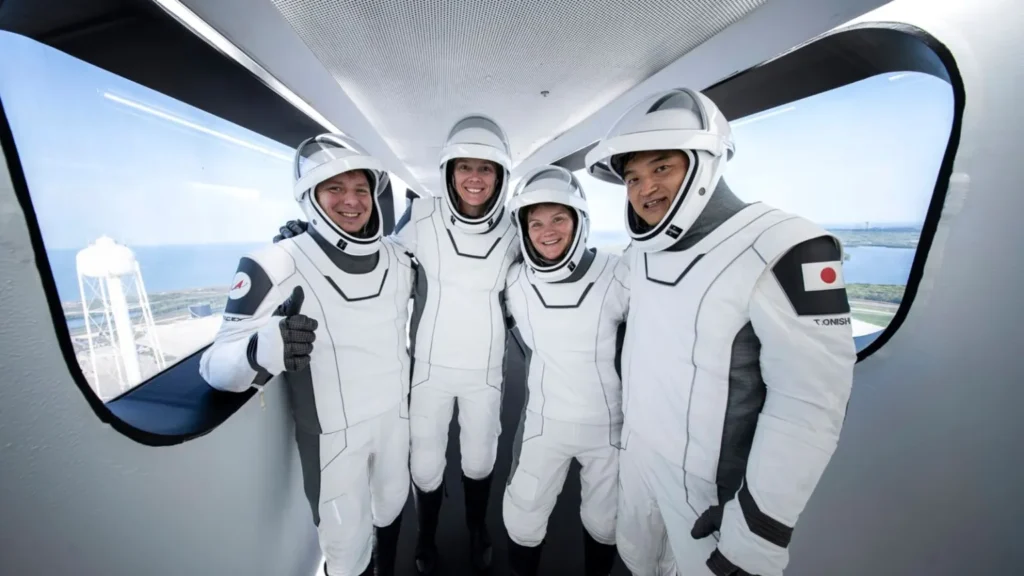

Staying on the International Space Station (ISS) for nine months were NASA astronauts Sunita Williams and Butch Wilmore. Their journey was supposed to be brief, but it dragged on. A new team of four astronauts arrived ISS today, while Sunita and Wilmore prepare to return home.
Staying so many months in orbit is not simple, though. Space causes numerous alterations in the human body. Let us clarify what actually goes on.
Does space cause body weakness?
Body does indeed get weak in space. No gravitational force means no pressure on muscles or bones. That causes bones to begin calcium loss. Bones lose around 1% strength every month. This is extremely risky. Bones turn weak and brittle after several years.
Also, muscles—especially in legs and back—become small and weak. Upon return to Earth, astronauts are unable to walk normally.
To prevent this, astronauts work out tough for two to two and a half hours every day. On treadmill (with straps), they cycle, run, and do weight training. Complete protection is, nevertheless, still not possible. Muscles and bones yet lose strength.
Why do astronauts experience puffy face?
Blood and other body fluids float in space. Gravity drags blood down to legs on Earth. That does not occur in space. Hence, fluid ascends to head.
Because of this:
The face is swollen.
Your nose closes off.
Eyes encounter stress.
Some astronauts have distorted sight.
Even their eye form could alter. It interferes with vision. Using fresh space suit helmets and artificial gravity concepts, scientists are attempting to fix this.
Does space alter brains?
Brain needs to adapt to gravity in zero gravity; hence, brain also change in space. Astronauts experience dizziness, fall down, and cannot walk straight upon returning.
According to recent studies, a region of the brain regulating spinal fluid grows in size. Returning to normal from this change takes many months, sometimes two to three years.
Furthermore impacting mental health is spending extended time in space. Space is limited, calm, distant from Earth, no new air. Astronauts occasionally suffer loneliness, boredom, or stress. That is why space agencies today also prepare astronauts for mental fortitude.
Could Space Cause Cancer?
This is serious anxiety, yes.
Cosmic radiation is kept away from us on Earth by the magnetic field and atmosphere. That defense is not present in space. Astronauts are exposed to more radiation, which might:
Damage cellsAffect DNAIncrease chance of cancer
Better spacecraft, robust shields, and medications to lower this risk are being developed by NASA and researchers.
This is quite crucial for a voyage to Mars. Six to eight months one way is the length of that travel. One must have defense.
What Will Happen When They Come Back to Earth?
After a long absence, coming back to Earth is quite challenging. Astronauts sense:extremely tireddisorientedweak muscleslegs aching
Problem with walking or standing
Loss of harmony
They also weigh heavily; after months of zero gravity, Earth gravity feels tough.
Their immune system also deteriorates. Body cannot effectively combat bacteria. Thus physicians closely inspect patients and keep them under observation.
Metabolism also alters. Some lose weight; some have no hunger; some digest food differently. Becoming normal takes weeks or months.
Recovery Following Mission
Astronauts seek treatment following space. That translates in physical therapy, training, walking practice, and strength building. They gradually return to regular life.
Certain results last longer. Changes in the brain, bone frailty, or eyesight issues might take months or even years to completely recover.
But all of this is part of space exploration. They understand the danger. That explains why astronauts are real heroes.
In general Long journeys like Sunita Williams and Butch Wilmore’s 9-month stay demonstrate how much body experiences. Space affects several inner events, from feeble bones to brain pressure.
But science is coming forward. New foods, suits, medications, and exercises are keeping astronauts stronger.
Still, they need time to recover, care, and love when they come back to Earth. Though health takes first priority, space is the future.
Let’s hope Sunita and Wilmore have a gentle landing and a quick recovery! 🚀